---
title: "21st Century Classroom Design: How to Promote the 4 C's of Learning"
description: Discover how 21st century classroom design promotes the 4 C's of learning — communication, collaboration, critical thinking, and creativity — through flexible furniture and active learning environments.
image: https://blog.moorecoinc.com/hubfs/snap%20desk%20classroom%201200x600.jpg
---
[](https://www.moorecoinc.com/)

### RSS header - this is hidden
## [21st Century Classroom Design: How to Promote the 4 C's of Learning](https://blog.moorecoinc.com/21st-century-classroom-design)
Posted by [MooreCo Inc](https://blog.moorecoinc.com/author/mooreco-inc) on Feb 7, 2019, 1:16:00 PM
- [Tweet](https://twitter.com/share)
# 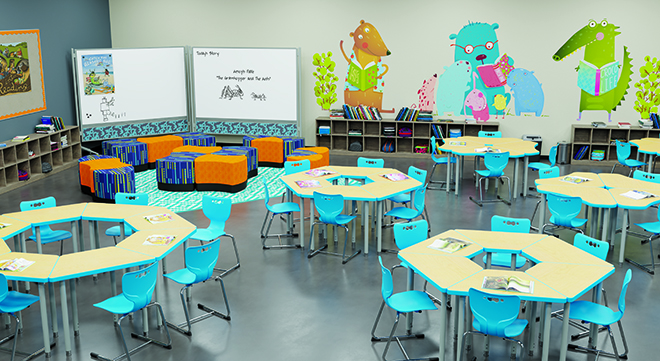
Walk into a traditional classroom from 30 years ago and a 21st century classroom today, and the difference is immediate. One has rows of fixed desks all facing forward. The other has furniture that moves, surfaces that invite writing, and zones designed for different kinds of thinking. The physical difference reflects a fundamental shift in how we understand learning itself.
That shift is codified in what educators call the 4 C's of learning — a framework developed by the [Partnership for 21st Century Skills (P21)](https://www.battelleforkids.org/networks/p21) to define the core competencies students need to succeed in modern academic and professional life: Communication, Collaboration, Critical Thinking, and Creativity.
Here's what the research tells us: classroom design is not a neutral backdrop to learning — it actively shapes which of these skills students get to practice. A [Brookings Institution review](https://www.brookings.edu/articles/evidence-based-reform-in-education/) of active learning research found that students in environments designed for engagement and movement significantly outperform those in traditional fixed-seating classrooms on measures of participation, retention, and collaboration. The room itself is part of the curriculum.
This guide breaks down each of the 4 C's of learning and explains exactly how 21st century classroom design — through furniture choices, layout decisions, and spatial zoning — creates the conditions for each one to flourish.
## What are the 4 C's of Learning?
The 4 C's framework emerged from research into what distinguishes high-performing graduates in the modern workforce. The Partnership for 21st Century Skills identified four competencies that traditional education often underserved: Communication, Collaboration, Critical Thinking, and Creativity. These are not soft skills — they are measurable, teachable, and directly linked to academic and career outcomes.
Critically, none of the 4 C's are well-served by a classroom where students sit in fixed rows, face forward, and receive information passively. Each one requires a physical environment that enables a different kind of interaction — with peers, with materials, with space itself.
## How 21st Century Classroom Design Supports the 4 C's
### 1. Communication: design for voice, visibility, and dialogue
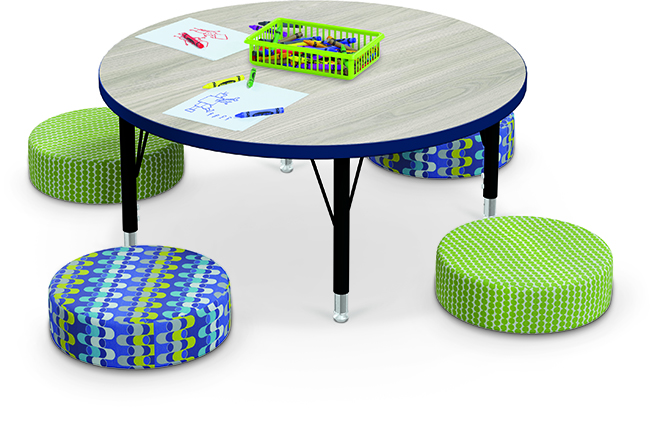
Communication is more than presenting to the class — it's the daily, low-stakes practice of articulating ideas, asking questions, listening actively, and adjusting to an audience. A classroom layout either makes this natural or it makes it awkward.
Traditional front-facing rows put the teacher's voice at the center and student voices at the margins. When a student speaks from the back of a row-format room, their peers see the back of their heads — hardly a setup for real dialogue. 21st century design fixes this structurally:
- Circular and pod-based seating arrangements ensure that when a student speaks, their peers can see their face — a basic requirement for genuine communication
- Writable surfaces on tables, walls, and mobile panels let students externalize thinking in real time, turning private thoughts into visible contributions others can respond to
- Multiple conversation scales should be designed for — the full-class discussion, the small-group exchange, the one-on-one check-in. Furniture that reconfigures quickly allows teachers to shift between all three within a single lesson
- Acoustic consideration matters: a classroom with hard floors and bare walls creates echo that makes it physically harder to hear and be heard. Soft seating, wall panels, and rugs help manage sound in active environments
Color also plays a documented role in communication confidence. Our post on [classroom colors that boost active learning](https://blog.moorecoinc.com/5-colors-in-the-classroom-that-will-boost-active-learning) covers how specific color palettes encourage participation versus withdrawal.
### 2. Collaboration: design for teamwork at every scale
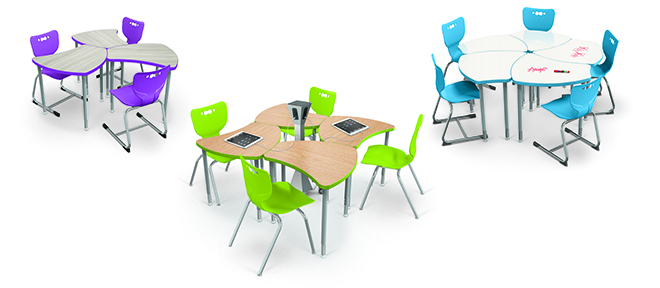
Collaboration is the ability to work productively with others toward a shared goal — and it requires the right physical infrastructure to happen consistently, not just occasionally. According to the [Edutopia flexible classrooms study](https://www.edutopia.org/practice/flexible-classrooms-providing-learning-environment-kids-need), classrooms specifically designed for collaborative work showed measurable improvements in student grades, engagement, and the depth of in-class conversations.
The study found that when students were given physical agency over their environment — including the ability to choose and rearrange their seating — they naturally organized into configurations that matched their current task. The furniture didn't force collaboration; it enabled the choice to collaborate.
Design strategies that build collaboration into the classroom structure:
- **Multi-group pods and cluster tables —** groupings of 4–6 students facing each other rather than the board. These are the baseline unit of collaborative classroom design. Tables with casters allow reconfiguration in under two minutes.
- **Shared writable surfaces —** tables with porcelain steel or whiteboard tops turn every group surface into a thinking and planning space. When students can write directly on the table, brainstorming becomes tactile and immediate.
- **Mobile display technology —** a portable display or interactive board that moves to where groups are working (rather than anchoring all attention to the front of the room) reinforces that collaboration happens everywhere in the classroom, not just at the teacher's station.
- **Designated maker and project zones —** a clearly defined area with flat surface space, storage for materials, and access to power supports longer-form collaborative projects that span multiple class sessions.
### 3. Critical thinking: design for inquiry, independence, and depth
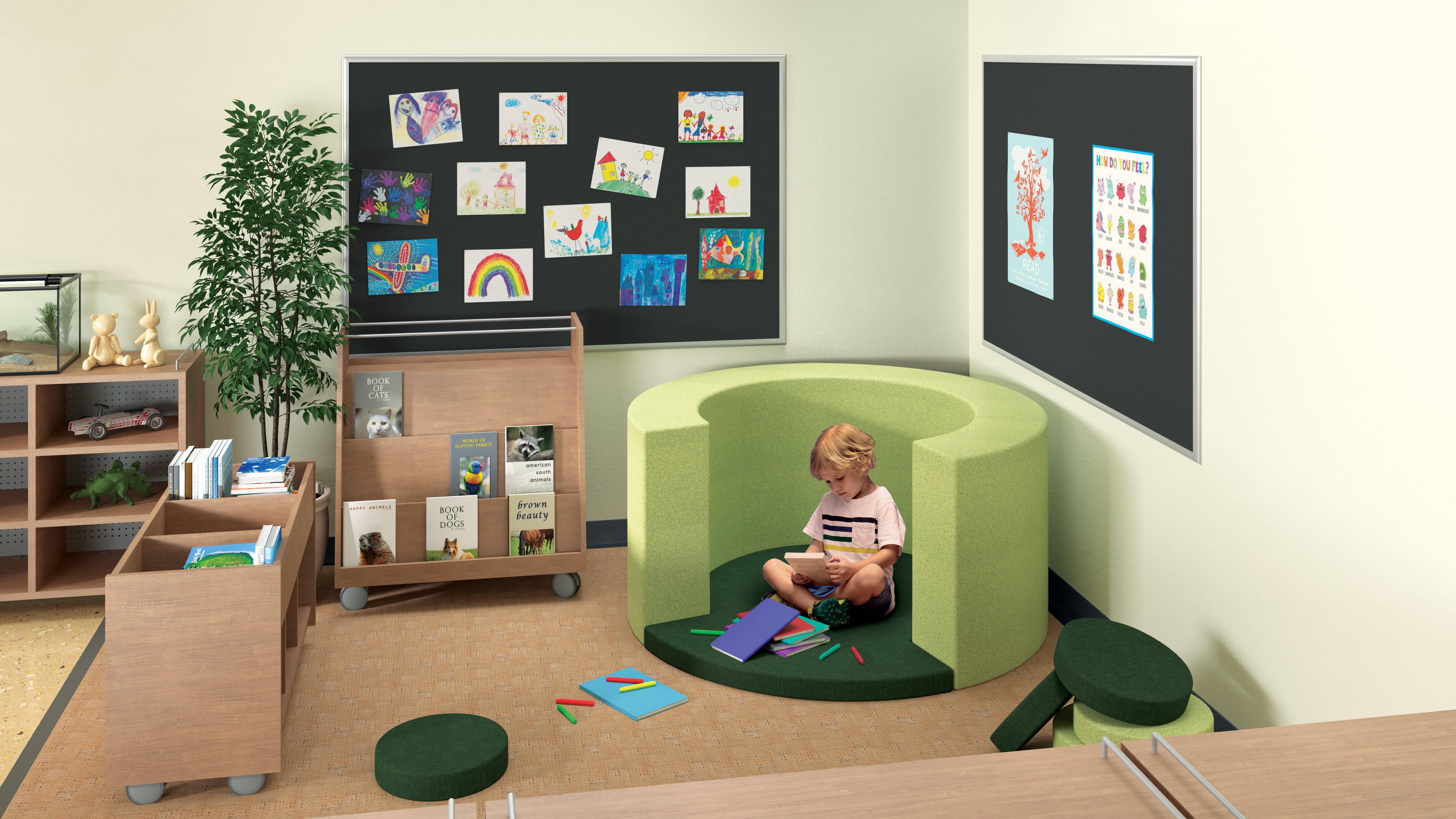
Critical thinking — the ability to analyze, evaluate, and form reasoned judgments — is the hardest of the 4 C's to design for directly, because it is primarily an internal cognitive process. But the environment can either support or suppress it.
Critical thinking is suppressed when students are passive, when they feel observed and evaluated at all times, and when there is no physical space for the kind of slow, independent engagement that deep analysis requires. It is supported when students have:
- Quiet, semi-private zones — study nooks, privacy pods, or simply a section of the room with individual seating away from group activity — where focused, uninterrupted thinking is the default
- Access to resources in the room itself — reference materials, display surfaces with relevant information, and tools for visual thinking (sticky notes, markers, lapboards) that support active engagement with ideas
- Height-adjustable furniture that lets students stand while they think, which research consistently links to greater alertness and cognitive engagement compared to prolonged sitting
- A layout that separates high-stimulation collaborative zones from low-stimulation independent zones — so students can move between modes of thinking without leaving the classroom
The connection between physical environment and cognitive engagement is a core principle of MooreCo's Thrive Philosophy. Read more in our post on the [6 stages of human development that inspire design strategies](https://blog.moorecoinc.com/6-stages-of-human-development-that-inspire-design-strategies), particularly the sections on intellectual and psychological development.
### 4. Creativity: design for exploration, experimentation, and expression
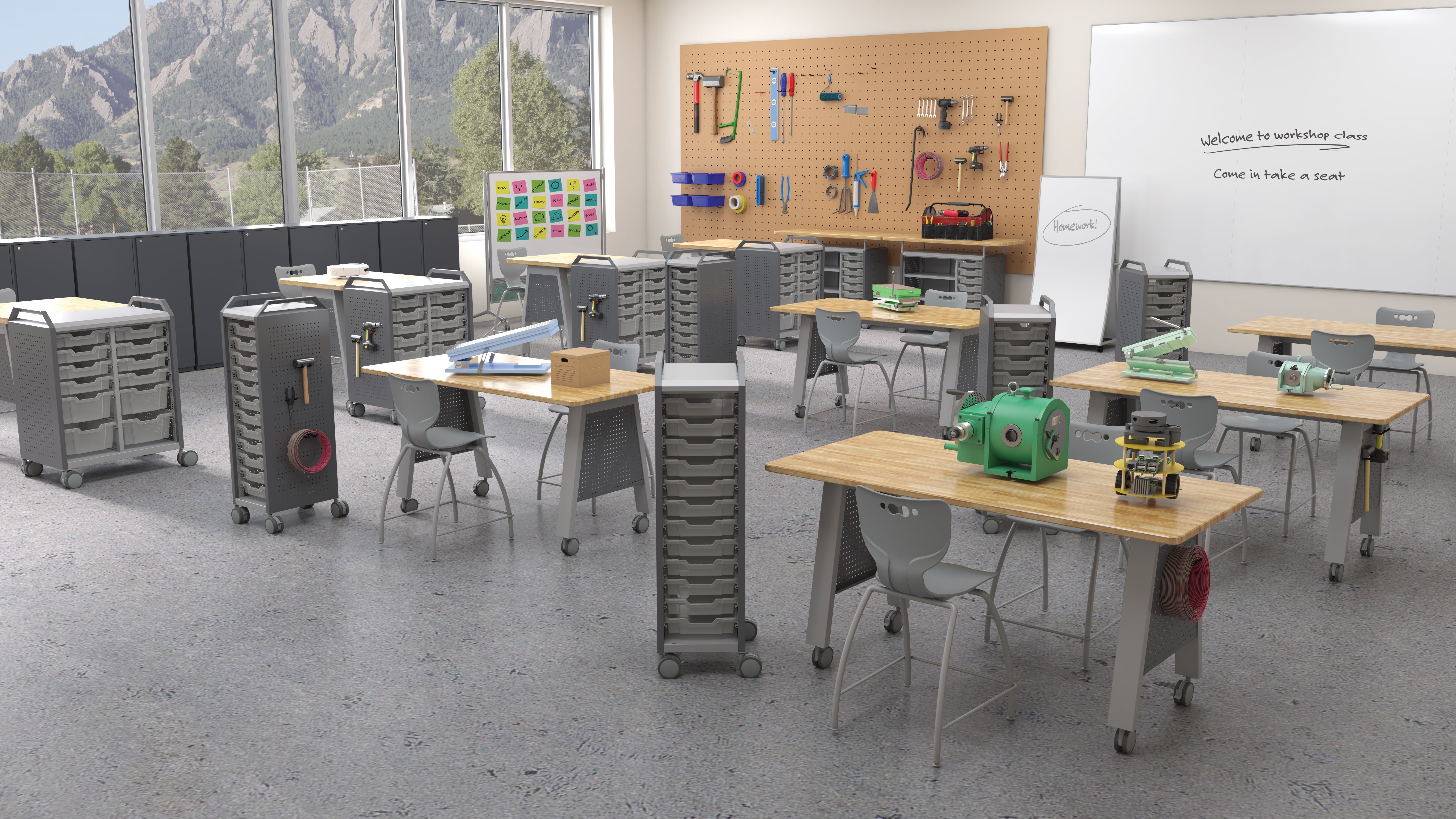
Creativity in an educational context isn't just about art — it's about generating novel solutions, making unexpected connections, and being willing to try something that might not work. The [American Institutes for Research](https://www.air.org/topic/k-12-education) notes that student creativity is directly linked to engagement: students who feel free to experiment are more motivated, more persistent, and more likely to take on challenging tasks.
Creativity requires a specific set of environmental conditions that most traditional classrooms don't provide: room to spread out, surfaces that welcome impermanence (writing that can be erased, arrangements that can be undone), and the psychological safety of knowing that the space itself is designed for experimentation, not just neat compliance.
Design features that unlock creativity:
- **Writable walls and surfaces throughout the room —** when students know they can write on the table, the wall panel, or the glass board, the barrier between idea and expression collapses. Porcelain steel surfaces and glass boards make entire walls into creative canvases.
- **Flexible, open floor space —** the ability to push furniture to the perimeter and use the floor creates an open creative zone that no fixed-desk classroom can offer. This is especially important for project-based and maker activities.
- **Storage that makes materials accessible —** creativity is inhibited when supplies are locked away or difficult to access. Open shelving, mobile carts, and student-accessible storage lower the friction between having an idea and acting on it.
- **Color, light, and visual interest —** environments that feel stimulating and non-institutional encourage risk-taking and exploration. This doesn't require a major renovation — strategic use of color on one wall, the addition of plants, or the introduction of varied lighting can shift the psychological feel of a classroom significantly.
## The Physical Foundations of a 21st Century Classroom
Across all four C's, three design principles show up repeatedly as enablers: adaptability, student agency, and multi-modal options. Here's how they translate into practical furniture and layout decisions:
### Adaptable furnishings: the prerequisite for all 4 C's
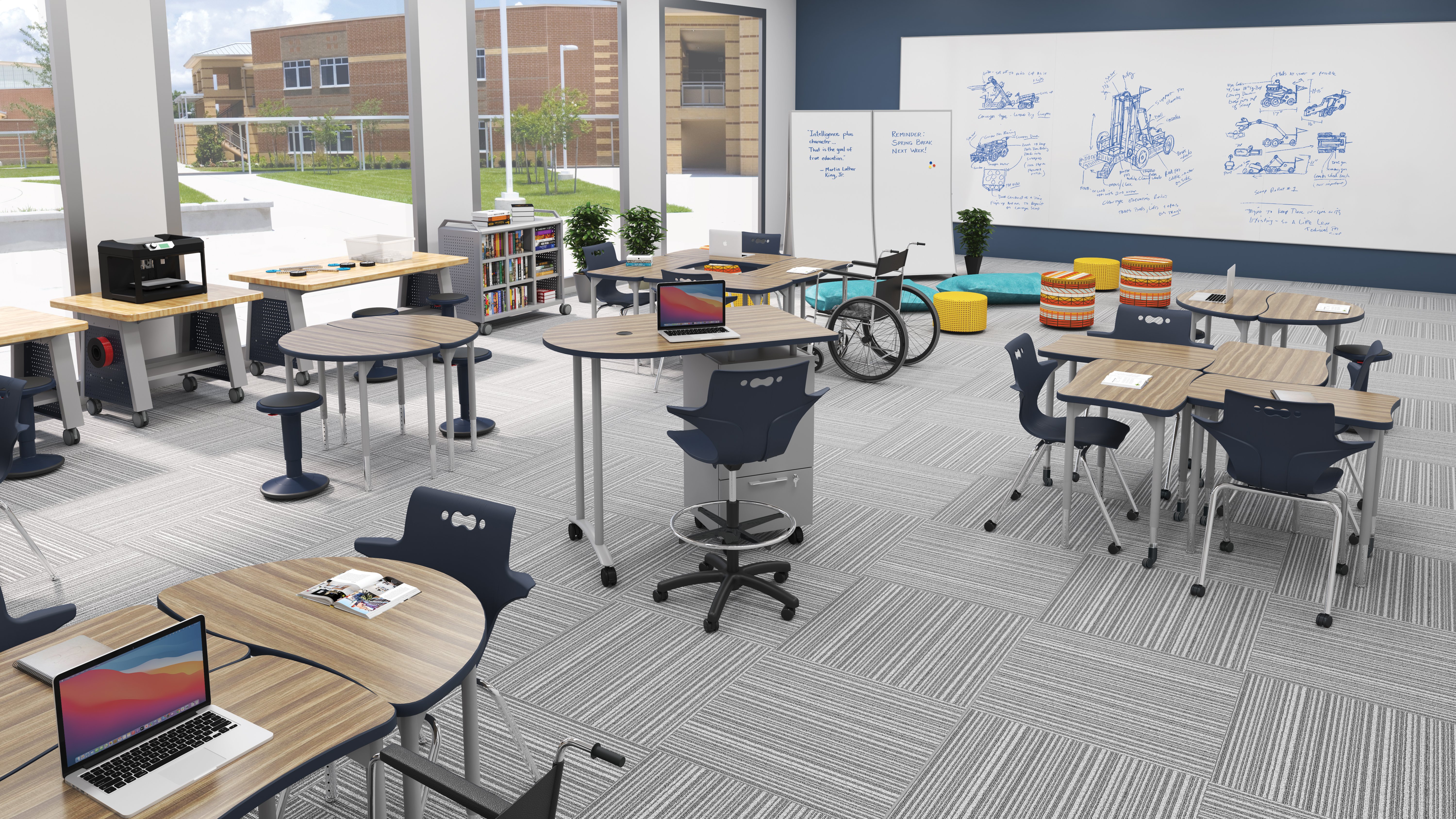
A classroom where furniture can't move is a classroom locked into one mode of learning. The ability to quickly reconfigure — from pods to rows to a full open floor — is the single most impactful physical feature a 21st century classroom can have.
What this looks like in practice:
- Tables and desks with locking casters that reconfigure in under two minutes without teacher intervention
- Lightweight chairs and stools that students can move themselves — agency over the environment builds the same confidence it's meant to support academically
- Nesting or folding tables that store flat against a wall, freeing the floor when open space is needed
- Mobile storage carts that follow the activity rather than anchoring it to one location
### Multiple seating modes: honoring different learners and different tasks
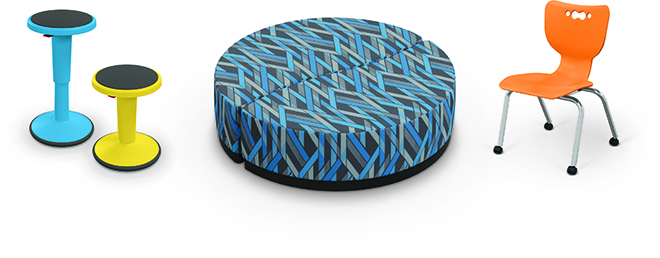
No single type of seating serves all students or all tasks. The [Edutopia research](https://www.edutopia.org/practice/flexible-classrooms-providing-learning-environment-kids-need) found that when students were given at least three seating options and the freedom to choose among them, both academic performance and emotional well-being improved. The options in a well-designed 21st century classroom typically include:
- Traditional chairs with desks for individual focused work and note-taking
- Active stools — wobble stools, grow stools, saddle stools — that allow micromovement while seated, supporting focus for kinesthetic learners
- Soft seating — lounge chairs, floor cushions, ottomans — for reading, individual reflection, and small-group discussion
- Standing options — height-adjustable desks and standing tables — for students who think better on their feet
For a deeper look at seating options and how they map to different learning needs, see our post on [8 ways to incorporate flexible seating into the classroom](https://blog.moorecoinc.com/8-ways-to-incorporate-flexible-seating-into-the-classroom).
### Collaborative learning spaces: where the 4 C's converge
The layout that most directly enables all four C's at once is the multi-group pod: clusters of 3–6 students arranged in small groups with shared surface space, positioned so every cluster has visual access to both a display surface and their peers. This is the workhorse configuration of 21st century classroom design.
Enhancements that multiply the impact of collaborative pods:
- Whiteboard tops on tables so groups have a shared thinking surface without needing to leave their seats
- A mobile display or screen that rotates to each pod rather than living permanently at the front of the room
- Clear pathways between pods so the teacher can circulate to each group without disrupting others
- Varied pod sizes (2-person, 4-person, 6-person) so the room supports different collaboration scales simultaneously
## Putting It All Together: What a 21st Century Classroom Looks Like
A fully realized 21st century classroom doesn't look like a single design — it looks like a collection of zones, each purpose-built for a different mode of learning, with the flexibility to reorganize as the lesson demands. A practical model:
- **Entry/transition zone:** hooks, cubbies, and a visible daily agenda board that orients students as they arrive and reduces transition time
- **Collaborative pods (center):** the primary zone for group work, discussion, and most daily instruction — tables with casters and writable surfaces, mixed seating options
- **Independent work zone (perimeter):** individual desks or a counter along one wall with acoustic buffering, for focused work that requires quiet
- **Creative/maker zone (corner or wall):** open floor space, accessible materials storage, and a writable wall surface for project-based and hands-on activities
- **Teacher station (flexible):** a mobile teacher workstation rather than a fixed desk, so the teacher's physical presence can move to where learning is happening
This structure isn't rigid — it's a starting point. Every classroom has different dimensions, different student populations, and different instructional styles. The 21st century classroom is defined not by a specific configuration but by the principle that the space should actively serve the people and the learning happening inside it.
## Design Your 21st Century Classroom With MooreCo
MooreCo has spent decades developing furniture and visual communication tools that bring 21st century classroom design principles to life — from height-adjustable collaborative tables to porcelain steel writable surfaces to flexible soft seating in every form factor.
Whether you're redesigning a single room or outfitting an entire school, our team can help you translate the 4 C's into a physical space that works. Explore our full product range at [moorecoinc.com](https://www.moorecoinc.com), or [contact our design team](https://www.moorecoinc.com/contact-us/) to get started.
Topics: [Collaboration](https://blog.moorecoinc.com/topic/collaboration), [Design](https://blog.moorecoinc.com/topic/design), [Active Learning](https://blog.moorecoinc.com/topic/active-learning), [Human Development](https://blog.moorecoinc.com/topic/human-development), [Active Classroom](https://blog.moorecoinc.com/topic/active-classroom), [Teacher's Favorites](https://blog.moorecoinc.com/topic/teachers-favorites), [Thrive](https://blog.moorecoinc.com/topic/thrive), [Learning Styles](https://blog.moorecoinc.com/topic/learning-styles), [Educators](https://blog.moorecoinc.com/topic/educators)
## About Us
Welcome to Thrive, a blog by MooreCo! We are designers and manufacturers of quality commercial and educational furniture and visual communication products. Our blog features industry related discussions, insight, resources, trends, and case studies. To learn more about our product offerings, please visit our website at [www.moorecoinc.com](https://www.moorecoinc.com).
### Subscribe to Email Updates
### Recent posts
### Posts by Topic
- [Design (55)](https://blog.moorecoinc.com/tag/design)
- [Thrive (55)](https://blog.moorecoinc.com/tag/thrive)
- [Active Learning (53)](https://blog.moorecoinc.com/tag/active-learning)
- [Human Development (53)](https://blog.moorecoinc.com/tag/human-development)
- [Active Classroom (52)](https://blog.moorecoinc.com/tag/active-classroom)
- [Educators (43)](https://blog.moorecoinc.com/tag/educators)
- [Collaboration (42)](https://blog.moorecoinc.com/tag/collaboration)
- [Technology (33)](https://blog.moorecoinc.com/tag/technology)
- [Learning Styles (32)](https://blog.moorecoinc.com/tag/learning-styles)
- [Well-Being (30)](https://blog.moorecoinc.com/tag/well-being)
- [Back-To-School (29)](https://blog.moorecoinc.com/tag/back-to-school)
- [Diversity, Equity, and Inclusion (27)](https://blog.moorecoinc.com/tag/diversity-equity-and-inclusion)
- [Covid-19 (26)](https://blog.moorecoinc.com/tag/covid-19)
- [Teacher's Favorites (24)](https://blog.moorecoinc.com/tag/teachers-favorites)
- [Experiential Learning (23)](https://blog.moorecoinc.com/tag/experiential-learning)
- [Hybrid Classroom (19)](https://blog.moorecoinc.com/tag/hybrid-classroom)
- [Designer's Corner (17)](https://blog.moorecoinc.com/tag/designers-corner)
- [CTE (16)](https://blog.moorecoinc.com/tag/cte)
- [generation z (16)](https://blog.moorecoinc.com/tag/generation-z)
- [Sensory Needs (15)](https://blog.moorecoinc.com/tag/sensory-needs)
- [Compass (14)](https://blog.moorecoinc.com/tag/compass)
- [Mental Health (14)](https://blog.moorecoinc.com/tag/mental-health)
- [New Products (13)](https://blog.moorecoinc.com/tag/new-products)
- [remote (12)](https://blog.moorecoinc.com/tag/remote)
- [Insider (11)](https://blog.moorecoinc.com/tag/insider)
- [Learning From Home (11)](https://blog.moorecoinc.com/tag/learning-from-home)
- [Case Studies (10)](https://blog.moorecoinc.com/tag/case-studies)
- [Media Centers (10)](https://blog.moorecoinc.com/tag/media-centers)
- [Working from Home (10)](https://blog.moorecoinc.com/tag/working-from-home)
- [Special Education (9)](https://blog.moorecoinc.com/tag/special-education)
- [Learn from Home (8)](https://blog.moorecoinc.com/tag/learn-from-home)
- [MooreCo Workplace (8)](https://blog.moorecoinc.com/tag/mooreco-workplace)
- [foam seating (8)](https://blog.moorecoinc.com/tag/foam-seating)
- [Clean Living (7)](https://blog.moorecoinc.com/tag/clean-living)
- [Color (7)](https://blog.moorecoinc.com/tag/color)
- [Higher Education (7)](https://blog.moorecoinc.com/tag/higher-education)
- [Ergonomics (6)](https://blog.moorecoinc.com/tag/ergonomics)
- [hybrid (6)](https://blog.moorecoinc.com/tag/hybrid)
- [i3sixty (6)](https://blog.moorecoinc.com/tag/i3sixty)
- [Healthcare (5)](https://blog.moorecoinc.com/tag/healthcare)
- [Expert Analysis (4)](https://blog.moorecoinc.com/tag/expert-analysis)
- [quick ship (4)](https://blog.moorecoinc.com/tag/quick-ship)
- [outdoor (3)](https://blog.moorecoinc.com/tag/outdoor)
- [Affordability (2)](https://blog.moorecoinc.com/tag/affordability)
- [Akt (2)](https://blog.moorecoinc.com/tag/akt)
- [Gen Alpha (2)](https://blog.moorecoinc.com/tag/gen-alpha)
- [Visual Communications (1)](https://blog.moorecoinc.com/tag/visual-communications)
- [Whiteboard (1)](https://blog.moorecoinc.com/tag/whiteboard)
- [holiday (1)](https://blog.moorecoinc.com/tag/holiday)
- [intergenerational classroom (1)](https://blog.moorecoinc.com/tag/intergenerational-classroom)
see all
Search the blog
- There are no suggestions because the search field is empty.
### Where are we?
2885 Lorraine Ave
Temple, TX 76501
### Contact us
Tel : [800.749.2258](tel:+18007492258)
Fax : 866.888.7483
Email: [info@moorecoinc.com](mailto:info@moorecoinc.com)
© 2026 MooreCo.