

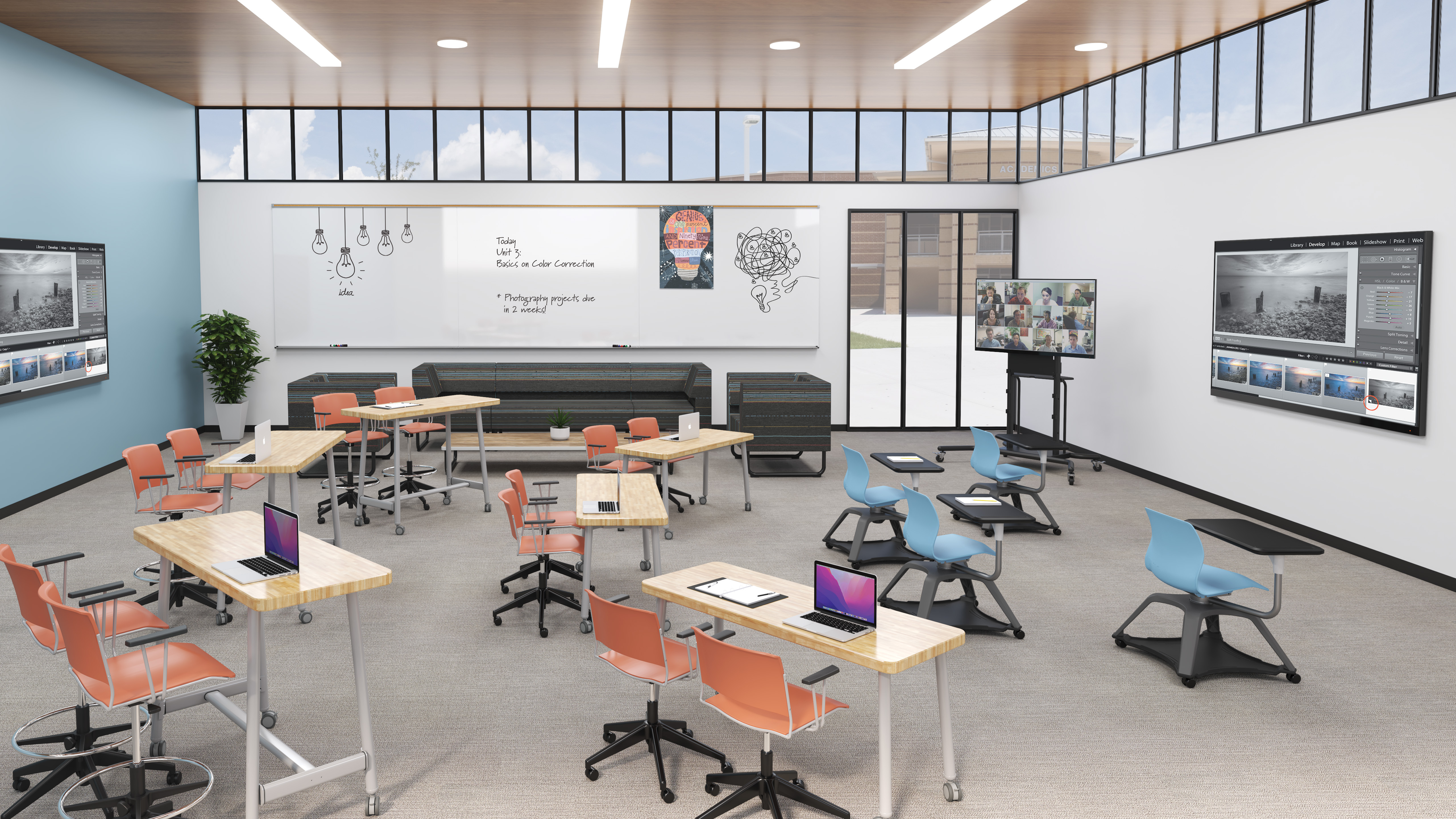
In April 2020, when schools across the country had been closed for weeks and no one knew when they would reopen, MooreCo published a list of predictions about what classrooms would look like when students came back. Five years later, those predictions have been tested against reality — and the results are instructive.
Some changes we anticipated proved temporary. Sneeze guards came down. Desk spacing requirements loosened. But many of the shifts we predicted have not reversed — they have deepened. The classroom of 2025 is measurably different from the classroom of 2019, not because of ongoing emergency measures, but because five years of necessity-driven experimentation revealed better ways to design learning spaces for how students actually learn.
A 2023 report by Education Week found that the majority of school administrators who adopted flexible furniture arrangements, hybrid-capable technology, and intentional wellness design during the pandemic have retained those changes permanently — citing improved student engagement and instructional flexibility as the primary reasons. The pandemic didn't create these ideas; it accelerated their adoption by a decade.
Here are the seven changes that have proven most durable, and what they mean for schools that are still in the process of updating their physical environments.
The 7 Permanent Changes
1. Flexible furniture replaced fixed rows as the classroom default
Before 2020, flexible classroom furniture was a progressive design choice made by forward-thinking schools. After 2020, it became a practical necessity. When schools needed to reconfigure classrooms overnight — spacing desks apart, creating cohort zones, accommodating rotating attendance — schools with fixed furniture simply couldn't adapt. Schools with mobile, caster-equipped tables could.
The Brookings Institution has documented that the ability to reconfigure classroom layouts quickly is now among the top design priorities for school administrators making furniture purchasing decisions — a significant shift from pre-pandemic priorities, which tended to focus on durability and cost per unit above all else.
What this looks like in classrooms that have made the permanent shift:
- Tables with locking casters as the default — not a specialty item — so any teacher can reconfigure the room for any instructional format without facilities support
- Nesting or folding tables that store flat, freeing floor space for project-based and movement-based learning
- Lightweight chairs and active stools that students can move themselves, supporting the student agency that active learning research consistently links to better outcomes
For a full breakdown of flexible furniture options and how they support different learning activities, see our post on 21st century classroom design and the 4 C's of learning.
2. Student mental health became a physical design consideration
Before the pandemic, student mental health was primarily addressed through counseling staff and curriculum. After it, the research base for physical environment as mental health infrastructure became impossible to ignore. A 2023 report by the CDC on adolescent mental health found that rates of persistent sadness and hopelessness among high school students reached 42% in 2021 — the highest recorded level. Schools responded not just with counselors, but with spaces.
The design interventions that have proven most effective and most widely retained:
- Dedicated decompression zones within classrooms — a corner with soft seating, reduced stimulation, and calm color palette where students can self-regulate without leaving the room
- Biophilic design elements: plants, natural light, and organic materials that reduce cortisol and create a physiologically calming environment
- Reduced visual clutter and more intentional use of wall space — classrooms that were previously covered wall-to-wall in displays have moved toward cleaner, calmer visual environments
- Flexible lighting where possible — the ability to dim overhead fluorescents and supplement with warmer, lower-level light shifts the mood of a room dramatically
These principles are grounded in the psychological development stage of MooreCo's Thrive Philosophy — the recognition that physical environments either support or suppress students' capacity to regulate, engage, and thrive. Read more in our post on the 6 stages of human development that inspire design strategies.
3. Hybrid-ready technology became standard infrastructure, not a specialty setup
In 2019, a classroom with a webcam, a quality microphone array, and a wall-mounted interactive display was a premium setup. By 2022, it was a baseline expectation. The schools that invested in permanent hybrid infrastructure — rather than cobbling together laptop cameras and consumer-grade speakerphones for emergency use — are the ones that have retained genuine instructional flexibility.
According to EDUCAUSE research on hybrid learning, institutions that installed permanent AV infrastructure (ceiling microphones, room cameras, integrated displays) during or after the pandemic report significantly higher rates of hybrid instruction use than those that rely on portable or improvised setups. The infrastructure determines whether hybrid teaching is effortless or effortful — and teachers consistently choose the former.
The permanent hybrid classroom infrastructure that has become standard in well-equipped schools:
- Wall-mounted interactive displays (65 inches or larger) with integrated or ceiling-mounted cameras that capture the full room — not just the teacher
- Omnidirectional microphone arrays that pick up student voices from any position in the room, making remote learners genuine participants in classroom discussion
- Reliable, high-bandwidth WiFi as non-negotiable infrastructure — device programs fail on inadequate networks
- An LMS (learning management system) where all materials, recorded sessions, and assignments live, accessible equally to in-person and remote students
For a detailed breakdown of what makes hybrid classroom technology actually work, see our post on what is a hybrid classroom.
4. Small-group and cohort-based learning structures became permanent pedagogy
Cohort structures — dividing students into small, consistent learning groups — were introduced in many schools during the pandemic as a containment strategy. What administrators discovered in the process was that the pedagogical benefits of small, consistent learning communities outlasted the safety rationale for them.
Schools that maintained cohort structures after reopening fully reported higher student engagement, stronger peer relationships, and more effective differentiated instruction. The Johns Hopkins Everyone Graduates Center research on cohort-based learning documents consistent improvements in attendance, assignment completion, and sense of belonging — all outcomes that became especially critical during and after the pandemic's impact on student connectedness.
The physical classroom changes that support permanent cohort structures:
- Pod tables as the default layout — clusters of 4–6 students that become a consistent home base rather than a temporary grouping
- Visual zone identity for each cohort — distinct color chairs, named zones, or dedicated wall space — that reinforces group belonging
- Per-cohort writable surfaces (lapboards, whiteboard table tops, or nearby glass board panels) so each group has a shared thinking space
For a full implementation guide, see our post on the classroom cohort model: benefits, design, and how to get started.
5. Writable surfaces expanded from the front wall to every surface in the room
Before 2020, the typical classroom had one whiteboard: mounted at the front of the room, used by the teacher, facing rows of students. The pandemic's emphasis on reduced shared materials and increased individual student workspaces accelerated an existing trend toward distributed writable surfaces — and schools that made the investment have not reversed it.
The shift has been validated by active learning research consistently: when students can write on their own surface rather than waiting for access to a shared board, the frequency and quality of thinking-made-visible increases. Ideas get captured rather than lost. Collaboration becomes tactile rather than verbal-only.
The writable surface expansion that has become standard in post-pandemic classroom design:
- Porcelain steel whiteboard-topped tables that make every desk a thinking surface — durable, ghost-resistant, and covered by a lifetime surface guarantee
- Individual economy lapboards for each student — low-cost personal writable workspaces that replaced paper worksheets for many daily tasks
- Glass boards or large porcelain steel panels on side and back walls — expanding the classroom's writable real estate beyond the traditional front-wall whiteboard
For guidance on maintaining these surfaces, see our post on how to clean a whiteboard: dry erase boards, glass boards, and permanent marker removal.
6. Classroom storage and organization became a design priority, not an afterthought
The pandemic forced schools to rethink how materials were stored, distributed, and cleaned. The improvised solutions — individual supply bins for each student, mobile storage carts per cohort zone, materials that could be sanitized quickly — turned out to solve organizational problems that predated COVID entirely.
Teachers have consistently reported that the organizational systems adopted during the pandemic improved daily instructional flow — less time distributing and collecting materials, less confusion about where things belong, and better student independence in accessing what they need. The systems stayed because they worked.
The organizational design features that have proven most durable:
- Mobile storage per cohort zone — a Compass Cabinet or storage cart positioned within each pod area means materials are accessible without whole-class distribution and without students crossing the room
- Individual student storage — cubbies, hooks, or designated desk storage that gives each student a consistent, personal location for their materials reduces the daily friction of setup and cleanup
- Teacher mobile workstation — a mobile teacher station with integrated storage allows the teacher to circulate as a facilitator rather than returning to a fixed desk for every supply need
7. Student agency over the learning environment became a measurable outcome, not just a philosophy
Before the pandemic, student agency over the physical environment — the ability to choose where to sit, how to arrange the space, what seating type to use — was a practice associated with progressive education philosophy. After the pandemic, it became associated with something more concrete: research outcomes. A RAND Corporation study on pandemic-era learning found that students who had more control over their learning environment — including the physical setup of their workspace — showed greater academic resilience and sustained engagement during disrupted schooling than those in fully teacher-directed environments.
The mechanism is well-established in developmental psychology: when students make decisions about their physical environment, they practice the same executive function skills — planning, self-monitoring, and adjustment — that underlie academic performance. The classroom that invites agency is not just more comfortable; it is actively developing the capabilities that help students succeed.
What student agency looks like in classroom design:
- Genuine choice in seating — not just different types of furniture available, but an explicit invitation and expectation that students will choose based on their current task and learning mode
- Furniture that students can move themselves — lightweight, caster-equipped, sized for the age group — so that agency over the environment is physically accessible, not just theoretically offered
- Rotating cohort responsibilities including room setup and transition — students who help configure the space develop ownership of it
This principle is the foundation of MooreCo's Thrive Philosophy. For the research basis behind it, see our post on 8 ways to incorporate flexible seating into the classroom.
What These Changes Have in Common
Looking across all seven shifts, a pattern emerges: the classroom changes that have proven most durable are those that were already grounded in evidence before the pandemic. Flexible furniture, student agency, small-group structures, distributed writable surfaces, and intentional wellness design all had strong research support before 2020. The pandemic didn't invent them — it removed the institutional inertia that had slowed their adoption.
Schools that approached pandemic-era changes as permanent upgrades rather than temporary emergency measures are now operating classrooms that are measurably better — more adaptive, more student-centered, and more resilient to future disruptions. The question for schools that haven't yet made these transitions is no longer whether the evidence supports them. It's whether the physical environment is ready to.
Design Your Post-Pandemic Classroom With MooreCo
MooreCo has been designing furniture and visual communication tools for learning environments for over 35 years. The products that serve post-pandemic classrooms best are the same ones built on the principles of our Thrive Philosophy: flexible, durable, student-centered, and designed for the full arc of how people learn.
Whether you're making targeted updates to an existing classroom or planning a full redesign, we can help. Explore our full catalog at moorecoinc.com, or contact our design team to discuss your space.
Topics: Collaboration, Design, Active Learning, Human Development, Active Classroom, Hybrid Classroom, Well-Being, Thrive, Educators