

.jpg?width=1200&name=Isometric%20Opti%20Classroom%20After%20(1).jpg)
School budgets are finite. The demands on them are not. When administrators and procurement teams are evaluating classroom redesigns, the question is never whether blended learning is worth investing in — research consistently says it is — but how to implement it in a way that delivers lasting instructional value without overextending limited funds.
The good news is that a high-functioning blended learning classroom does not require a complete overhaul or a premium price tag. The Christensen Institute, which has studied blended learning implementations across thousands of schools, consistently finds that the most successful programs are those where intentional instructional design and smart furniture choices drive outcomes — not the most expensive technology on the market.
This guide breaks down the blended learning classroom setup into its core components — furniture, technology, and space design — and identifies where to invest, where to economize, and what decisions have the greatest impact on day-to-day instructional effectiveness. The goal is a classroom that serves both in-person and remote learners well, holds up over years of use, and fits within a realistic school procurement budget.
Where to Invest: The High-Impact Essentials
Not every dollar spent on a blended learning classroom returns equal value. These are the areas where quality investment genuinely pays off over time.
1. Flexible, mobile furniture — the highest ROI classroom investment
The single most impactful investment in a blended learning classroom is furniture that moves. According to RAND Corporation research on school technology integration, the physical flexibility of a classroom — the ability to reconfigure quickly between instructional formats — is one of the strongest predictors of whether blended learning gets used consistently or falls back to lecture-only defaults. Fixed furniture is the quiet killer of blended learning programs.
What this looks like in practice:
- Tables with locking casters that students can rearrange themselves in under two minutes — from rows to pods to a full open floor — without teacher intervention or disruption to adjacent classes
- Lightweight chairs and stools that don't require effort to move, so the friction of reconfiguring the room is low enough that teachers actually do it multiple times a week
- Nesting or folding tables that store flat when floor space is needed for project-based activities, presentations, or movement-based learning
On a budget, prioritize mobile tables over mobile chairs — a basic chair on glides is easier to move than a heavy fixed table, and table mobility is what drives layout flexibility. Buy fewer, higher-quality mobile tables rather than a full set of inexpensive fixed ones that will need replacing in three years.
2. Writable surfaces — the most underrated blended learning tool
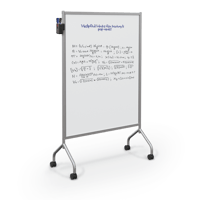
Writable surfaces — tables with porcelain steel tops, wall-mounted glass boards, and portable lapboards — are among the most cost-effective investments in a blended learning classroom because they serve every instructional format simultaneously: direct instruction, group work, individual practice, and project creation.
The hierarchy of writable surface investment, from highest to lowest ROI:
- Porcelain steel whiteboard table tops — the most durable and functional upgrade available at the table level. Porcelain steel resists ghosting, accepts magnets, cleans easily with standard erasers, and carries a lifetime guarantee. When a student's table is a writable surface, every desk becomes a thinking tool. This is especially valuable in blended classrooms where students frequently move between digital and handwritten work.
- Economy lapboards — individual portable whiteboard surfaces that give every student a personal writable workspace independent of their desk surface. Low cost, extremely durable, and easy to clean with a damp cloth. In a blended classroom, lapboards eliminate the paper waste of individual printed worksheets and give students a tactile, low-tech alternative to screens that remains accessible when devices are charging or unavailable.
- Wall-mounted glass boards or porcelain steel panels — a single large writable wall surface transforms the front (or any wall) of the classroom into an active collaborative and display space. Glass boards are premium but deliver the clearest writing surface and the cleanest visual. Porcelain steel panels are the durable, budget-conscious alternative with equivalent writing quality.
For guidance on keeping these surfaces performing at their best, see our post on how to clean dry erase whiteboards and glass boards — proper maintenance significantly extends surface life and preserves legibility.
3. A mobile teacher workstation — the operational center of a blended classroom
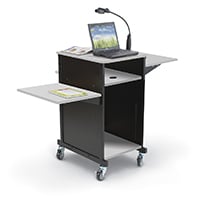 In a blended classroom, the teacher's role shifts from front-of-room lecturer to circulating facilitator — moving between student groups, checking in on digital progress, pulling small groups for direct instruction, and monitoring the room as a whole. A fixed teacher desk at the front of the room works against this model structurally.
A mobile teacher workstation — lightweight, on casters, with integrated storage and a laminate top — allows the teacher to position themselves wherever the instruction is happening. This has a direct impact on student engagement: when the teacher can move to where students are, rather than requiring students to always come to the teacher, the dynamic of the room shifts toward student-centered learning.
Practical features to prioritize in a mobile workstation:
- Locking casters so the station stays put when the teacher is working at it and moves easily when repositioning
- Integrated storage for frequently needed materials — charging cables, assessment tools, reference binders — so the teacher isn't making repeated trips across the room
- A laminate or easy-clean top surface that withstands daily use without showing wear
- A compact footprint that doesn't consume valuable floor space when positioned in the center or perimeter of the room
4. Per-student technology access — the honest ROI calculation
Technology is where blended learning budgets most commonly run over. The Association for Supervision and Curriculum Development (ASCD) has noted consistently that 1:1 device programs often underperform when the physical classroom environment isn't designed to support them — students end up on devices doing the same passive activities they would have done on paper, just on a screen. The device is not the investment; the instructional design around the device is.
For budget-conscious blended learning setups, consider:
- Shared device carts rather than 1:1 — a cart of 15 Chromebooks shared between two classrooms delivers better total value than 30 devices per room that spend significant time idle or charging. Match device access to actual instructional need rather than maximum possible use.
- Charging infrastructure built into furniture — tables with integrated power access (grommets, USB ports, or nearby outlet strips) eliminate the tangle of extension cords that characterize under-planned device programs and reduce cable damage over time.
- Robust WiFi before more devices — no blended learning program functions reliably on inadequate network infrastructure. If the choice is between more devices and better WiFi, invest in the network first. Devices are useless on a slow or intermittent connection.
Where to Economize Wisely
Budget-conscious classroom design isn't only about where to spend — it's equally about where you can confidently spend less without compromising instructional quality.
Seating: durability over aesthetics
Premium seating is a budget line that schools routinely over-invest in. The most impactful seating characteristic in a blended classroom is not comfort or appearance — it's variety and mobility. A classroom with three types of seating (standard chairs, active stools, and one or two soft seating options) will outperform a classroom with one type of very expensive chair, because variety supports different learners and different activities.
Practical economizing strategy: buy the majority of your seating in standard, durable stackable or caster chairs, and allocate a smaller portion of the budget to two or three active seating options (wobble stools, grow stools) and a small soft seating area for reading or independent work. This approach gives students genuine choice — the core requirement for student-centered blended learning — without a premium per-unit cost.
See our post on 8 ways to incorporate flexible seating into the classroom for a full breakdown of seating options at every price point.
Storage: functional and mobile beats built-in
Built-in cabinetry is expensive, inflexible, and typically requires contractor work. Mobile storage — carts, cabinets on casters, open shelving units — costs significantly less, can move as the room's needs change, and can be repositioned to act as soft zone dividers between activity areas.
In a blended learning classroom, storage serves two functions: materials management (supplies, devices, reference books) and spatial definition (mobile storage units between activity zones create visual separation without walls). Investing in mobile, well-made storage units serves both functions while remaining flexible as the instructional model evolves.
Display surfaces: prioritize function over size
A 98-inch interactive display is impressive. A well-positioned 65-inch display with quality resolution and reliable connectivity is functionally equivalent for most K-12 classroom instruction — and typically costs 40-60% less. Size matters less than placement, brightness, and the quality of the mounting solution that ensures the screen is within the camera frame for hybrid sessions and visible from every seat in the room.
For most blended classrooms, one primary display (interactive or standard) plus a robust writable surface (glass board or porcelain steel panel) covers the full range of instructional needs at significantly lower cost than multiple large-format displays.
A Practical Budget-Conscious Blended Classroom: The Full Setup
Bringing these principles together, here is a practical equipment and furniture list for a blended learning classroom serving approximately 24–28 students, organized by priority:
Tier 1: foundational investment (highest priority)
- 6–8 collaborative tables with locking casters and porcelain steel whiteboard tops — the workhorse furniture of the blended classroom
- 24–28 lightweight chairs or active stools with glides or casters — prioritize mobility and durability over aesthetics
- 1 mobile teacher workstation with integrated storage and laminate top
- 1 wall-mounted display (65 inches or larger) with mounting hardware and cable management
- WiFi infrastructure assessment and upgrade if needed (coordinate with IT — this is a prerequisite, not optional)
Tier 2: high-value additions
- 1 glass board or large porcelain steel panel (wall-mounted) for shared writing and display surface
- 24–28 economy lapboards for individual student writable workspaces
- 1 shared device cart (12–16 Chromebooks or tablets) with integrated charging
- Webcam and microphone array for hybrid-capable sessions
- 2–4 mobile storage units or Compass Cabinets for materials and zone definition
Tier 3: enhancement investments (implement as budget allows)
- 2–4 active seating options per classroom (wobble stools, grow stools) to supplement standard chairs
- Small soft seating area (2–4 pieces) for independent reading and quiet work zone
- Acoustic panels or rugs to manage sound in an active, reconfiguring classroom
- Power access integration (outlet strips, table grommets) as tables are replaced or upgraded
MooreCo's Quick Ship Program: Planning Tool, Not Emergency Measure
One genuine advantage MooreCo offers budget-conscious school procurement teams is the Quick Ship program — a curated catalog of in-stock furniture with 2–10 day lead times and volume pricing that reduces per-unit cost when ordering full lot or pallet quantities.
For schools planning a blended learning classroom transition, Quick Ship is most valuable as a planning tool, not a last-minute solution. Knowing that specific products are available with fast lead times allows procurement teams to stage purchases across a fiscal year — ordering Tier 1 essentials before the school year begins and Tier 2 additions mid-year as budget becomes available — without committing to a full build-out in a single purchase order.
Volume pricing on Quick Ship products is particularly relevant for multi-classroom or school-wide blended learning initiatives, where the cost difference between standard and lot pricing across 20 classrooms is substantial.
The Long-Term View: Blended Learning as a Permanent Instructional Model
The most important reframe for school administrators evaluating blended learning investment is the durability of the model itself. Blended learning is not a trend or a workaround — it is the direction that modern education is moving, accelerated by five years of institutional experience with hybrid and digital instruction. Education Week consistently reports that schools that invested in flexible, technology-integrated learning environments during and after the pandemic have retained those models by choice, because the instructional outcomes justify the physical investment.
Furniture purchased for a blended learning classroom — mobile tables, writable surfaces, a mobile workstation — does not become obsolete when the instructional model evolves. It serves active learning, project-based learning, collaborative learning, and direct instruction equally well. The ROI is not specific to blended learning; it is specific to a flexible, student-centered approach to classroom design that serves every teaching model that requires it.
That is the foundation of MooreCo's Thrive Philosophy. To learn more about the principles behind our approach to learning environment design, read our post on the 6 stages of human development that inspire design strategies.
Ready to Design Your Blended Learning Classroom?
MooreCo's furniture and visual communication products are built to serve blended learning environments at every budget level — from a single classroom refresh to a full school-wide redesign. Our Quick Ship program, volume pricing, and design consultation services make it practical to move from plan to implementation efficiently.
Explore our product catalog at moorecoinc.com, or contact our design team to discuss your space, student population, and budget.
Topics: Design, Active Learning, Active Classroom, Technology, Back-To-School, Hybrid Classroom, Affordability, Thrive, Educators