---
title: 5 Classroom Design Trends Shaping Schools Learning Spaces Today
description: From biophilic spaces to flexible furniture to equity-centered design, here are the 5 classroom design trends leading educators and architects are building around right now.
image: https://blog.moorecoinc.com/hubfs/viscom_tackboards___rails_section_divider_720.jpg
---
[](https://www.moorecoinc.com/)

### RSS header - this is hidden
## [5 Classroom Design Trends Shaping Schools Learning Spaces Today](https://blog.moorecoinc.com/5-changes-in-classroom-design-to-expect-in-2021)
Posted by [MooreCo Inc](https://blog.moorecoinc.com/author/mooreco-inc) on Oct 1, 2020 4:13:34 PM
- [Tweet](https://twitter.com/share)
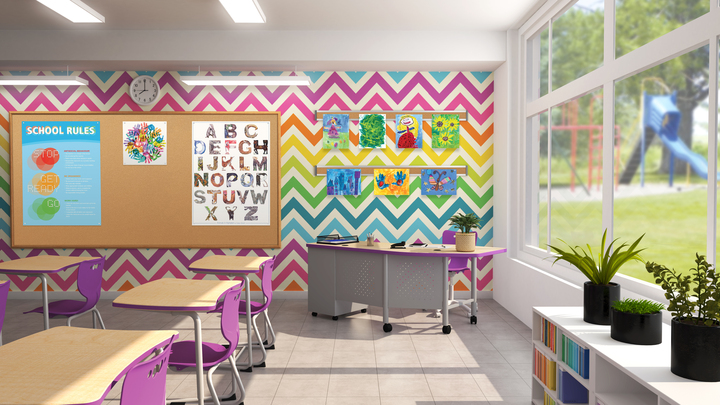
The classroom is in the middle of its most significant design evolution in decades. The combination of post-pandemic instructional realities, a deepening research base on how environment affects learning, and five years of school administrators observing what actually works has produced a design direction that's more evidence-based, more student-centered, and more holistic than anything that came before it.
We spoke with **Steve Hulsey**, Education Sector Leader and President of [Corgan](https://www.corgan.com) — one of the most respected K-12 architecture and design firms in the country — about the design trends he and his team are seeing drive decisions in schools right now. What emerged from that conversation, and from the broader field of learning environment research, are five directions that are no longer emerging trends but established design priorities shaping new construction and renovation projects across K-12 and higher education.
Each of these trends has a research foundation, a practical implementation path, and specific furniture and design decisions that determine whether a school realizes the full benefit or only partially captures it.
## The 5 Trends
### 1. Flexibility: designing for multiple modes, not a single configuration
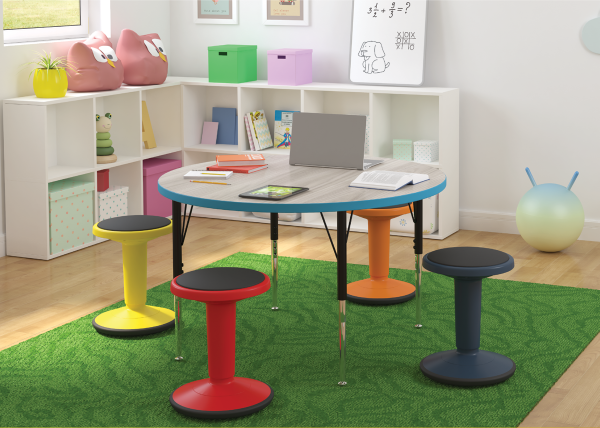
Hulsey identifies flexibility as the foundational shift in how schools are approaching new construction and renovation:
*"Flexibility has been needed across both primary and higher education, and we shouldn't expect that to change. The schools that handled disruption best were the ones that had designed flexibility in from the beginning — not as a contingency, but as a core feature."*
— Steve Hulsey, President, Corgan
What's changed is the scope of what flexibility means. A decade ago, a flexible classroom meant one where the teacher could rearrange the furniture for a special project day. Today, it means an environment that can support direct instruction, small-group collaboration, individual work, hybrid attendance, and project-based maker activities — sometimes in the same day — without requiring a facilities team.
A [2024 American Institute of Architects report on K-12 school design](https://www.aia.org/resources/6098-the-future-of-learning-environments) identified furniture flexibility as the single highest-priority design investment among school administrators planning major renovations — ahead of technology upgrades, outdoor space, and HVAC improvements. The physical ability to reconfigure the room quickly is now understood as the infrastructure that makes every other instructional innovation possible.
What designing for genuine flexibility looks like:
- Tables with locking casters as the universal default — lightweight enough for students to move themselves, stable enough to not drift during seated work
- A minimum of three seating types per classroom: active stools or wobble chairs, standard chairs, and at least a small soft seating area — so students can self-select the mode that supports their current task
- Nesting or folding tables along one wall for open-floor configurations when floor space matters more than desk space
- A mobile teacher workstation — not a fixed desk — so the teacher's physical center of gravity moves with the instruction rather than anchoring all attention to one corner of the room
For a detailed look at the furniture options that support flexible classrooms at every grade level, see our post on [8 ways to incorporate flexible seating into the classroom](https://blog.moorecoinc.com/8-ways-to-incorporate-flexible-seating-into-the-classroom).
### 2. Biophilic design: bringing nature in as a learning environment strategy

Biophilic design — the intentional integration of natural elements, materials, and spatial qualities into the built environment — has moved from an aesthetic preference to an evidence-based design strategy. Hulsey notes that architects and designers are increasingly incorporating biophilic principles not as decorative choices but as performance decisions:
*"We're designing more flow between indoor and outdoor spaces — spacious courtyards with student seating, laboratories with open walls and windows, spaces that easily convert to the outside. And we're bringing elements of the outside in, like plants in classrooms and offices, to purify the air and create a sense of calm."*
— Steve Hulsey, President, Corgan
The research foundation is strong. A landmark study by the [World Green Building Council](https://www.worldgbc.org/news-media/building-brain-neuroscience-of-space) found that access to natural light improves student performance on math and reading assessments by measurable margins, while exposure to natural elements reduces cortisol levels and improves sustained attention. The [WELL Building Standard](https://www.wellcertified.com/), which is increasingly applied to school buildings, identifies biophilic elements as core contributors to the cognitive and emotional performance of building occupants.
The biophilic interventions with the strongest return on investment in classroom settings:
- **Natural light maximization —** window placement, skylights, and light-reflective surfaces that reduce dependence on overhead fluorescent lighting, which has documented negative effects on mood and concentration in prolonged exposure
- **Indoor plants —** live plants (not artificial) in classrooms improve air quality by filtering volatile organic compounds, reduce stress markers in both students and teachers, and create a visual environment associated with calm and restoration. Low-maintenance species like pothos, snake plants, and peace lilies are ideal for school environments
- **Natural materials and textures —** wood accents, stone surfaces, woven fabrics, and organic colors (earth tones, greens, blues) create environments that feel grounded and calm rather than institutional. These can be introduced through furniture choices, flooring, and wall treatments without major construction
- **Outdoor-indoor transitions —** in new construction, designing classrooms with direct access to outdoor learning spaces dramatically expands the instructional environment and gives teachers a natural movement break option within the school day
Color is one of the most accessible biophilic design tools available to existing classrooms. For a detailed guide to using color to support active learning, see our post on [classroom colors that boost active learning](https://blog.moorecoinc.com/5-colors-in-the-classroom-that-will-boost-active-learning).
### 3. Equity-centered design: building environments that serve every student
The awareness of how unequally educational environments serve different student populations has sharpened significantly since 2020. Equity-centered classroom design addresses the physical and sensory needs of the full range of students — not just the median student the room was historically designed for.
What Hulsey describes as awareness of students' and parents' circumstances has broadened into a design framework with several distinct dimensions:
- **Sensory and physical diversity —** a classroom designed for one body type, one sensory profile, and one physical capacity serves some students well and others poorly. Varied desk heights, multiple seating types, acoustic management for students with auditory processing differences, and clear spatial organization for students who need visual predictability are all equity interventions, not luxury features.
- **Technology equity —** power access built into furniture (table grommets, outlet strips, charging stations) ensures that students without reliable home charging options are not disadvantaged by low-battery devices during the school day. This is a design-layer solution to an equity problem that no policy can fully solve.
- **Representation in the environment —** whose work is displayed on walls, whose language is visible in signage, and whose cultural context is reflected in the room's visual environment all communicate belonging — or the absence of it — to students who notice these things immediately and viscerally.
- **Universal Design for Learning (UDL) principles —** the framework that asks designers to create environments offering multiple means of engagement, representation, and expression. A UDL-informed classroom has multiple seating options, multiple access points to materials, and multiple ways for students to demonstrate what they know.
For a focused look at design for students with diverse attention and sensory needs, see our post on [how to create an ADHD-friendly classroom](https://blog.moorecoinc.com/how-to-create-an-adhd-friendly-classroom-test-a).
### 4. Wellness-centered spaces: designing the whole school environment for human health
Hulsey's observation that clean, orderly spaces with easy-to-disinfect furnishings were a priority has proven accurate — but the framing has evolved significantly. What began as a health-safety response has settled into a broader wellness design movement that addresses the physical environment's effect on both physical and cognitive health.
The [Salford University research on classroom design and academic performance](https://www.salford.ac.uk/news/articles/2015/classroom-design-can-boost-primary-school-pupils-progress-by-16-in-a-year) — which found that physical classroom design can affect academic progress by up to 16% in a year — identified air quality, natural light, temperature control, and acoustic management as the highest-impact environmental variables. All four are addressable through design decisions that schools are increasingly treating as non-negotiable rather than optional.
The wellness design elements most widely adopted by forward-thinking schools:
- **Non-porous, easy-clean surfaces —** porcelain steel desktops and table tops resist bacterial growth, don't absorb moisture, clean easily with standard products, and double as excellent writing surfaces. The Hierarchy Shapes Desk with porcelain steel top exemplifies this: a single product that serves instructional, collaborative, and wellness design goals simultaneously.
- **Air quality management —** updated HVAC systems, air quality monitors, and CO2 sensors have moved from pandemic contingency to standard school infrastructure. Research consistently links indoor air quality to student concentration, attendance, and long-term health outcomes.
- **Acoustic management —** excessive noise is one of the most consistently documented negative environmental factors in schools, affecting learning outcomes, teacher vocal health, and student stress levels. Soft seating, rugs, acoustic wall panels, and careful furniture arrangement all contribute to acoustic environments that support rather than impede learning.
- **Visual order and reduced clutter —** classrooms with clear organizational systems, accessible storage, and reduced visual complexity create calmer cognitive environments that reduce the attentional load on students with sensory sensitivities, anxiety, or ADHD — and benefit all students by reducing the mental overhead of navigating a chaotic space.
The Compass Collection of storage and organizational furniture supports this trend directly — mobile cabinets and storage units that keep materials organized and accessible while maintaining the visual order that wellness-centered classrooms require.
### 5. Resilient design: building for adaptability across whatever comes next
****
The fifth trend is perhaps the most strategically important and the least visible: designing schools not just for current needs but for future ones that can't be fully anticipated. Hulsey frames this as a departure from the traditional school design mindset of optimizing for a single defined use case:
*"Given the nature of how COVID-19 shut down businesses and schools rapidly, many are working to prepare for future unpredictable events. The blended model of working and learning is likely to stay — and it would be advantageous in a number of circumstances: climate disasters, inclement weather, family illness, or other national or personal circumstances that require flexibility."*
— Steve Hulsey, President, Corgan
Resilient design in the school context means physical environments that remain functional across a range of attendance configurations, technology states, and instructional formats. The schools that came through the pandemic with the least disruption to learning continuity were those whose physical environments had been designed with resilience as an explicit goal — not as an emergency contingency.
What resilient classroom design looks like in practice:
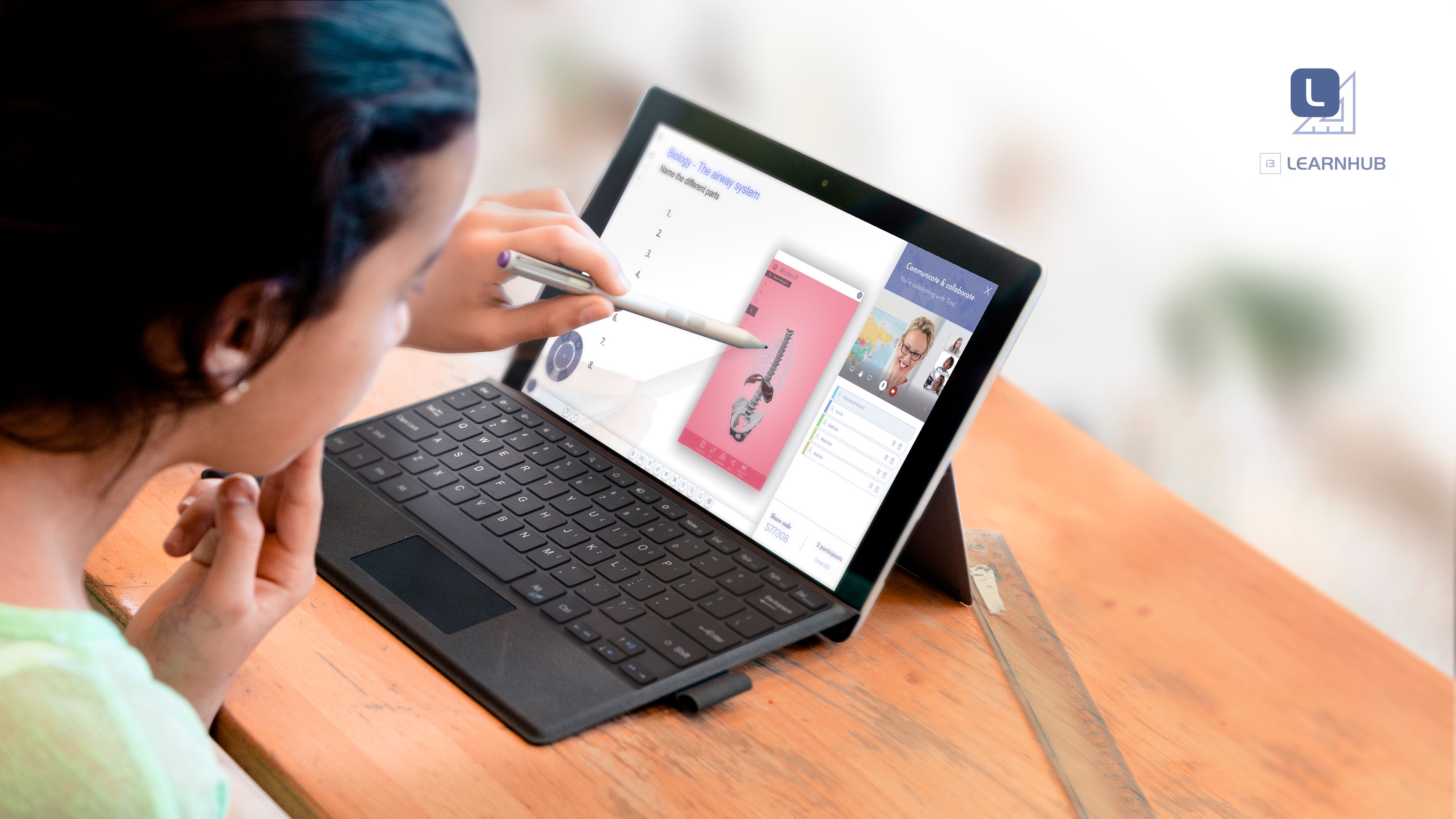
- **Hybrid-capable infrastructure as standard —** wall-mounted displays, ceiling cameras, and microphone arrays that make switching to remote or hybrid instruction seamless, not effortful. When hybrid is a built-in capability rather than an emergency workaround, the threshold for using it is dramatically lower.
- **Modular furniture systems —** furniture that can serve multiple configurations without replacement: tables that work in pods, rows, pairs, and open floor arrangements; storage that can be repositioned as zone dividers or perimeter units; seating that works for group work, direct instruction, and individual focus.
- **Technology-agnostic infrastructure —** electrical capacity, connectivity infrastructure, and mounting systems that support whatever technology exists now and can accommodate whatever replaces it, rather than being locked to a specific vendor or device ecosystem.
- **LMS-integrated instruction —** courses designed so that all materials, assignments, and communication live in a learning management system accessible from anywhere. This is not just a technology choice — it is a resilience design decision that determines whether a student who misses school for any reason falls behind or stays current.
For a comprehensive look at how the pandemic's design lessons are shaping current school environments, see our companion posts: [7 ways the pandemic permanently changed classroom design](https://blog.moorecoinc.com/7-predictions-on-back-to-school-in-a-post-covid-world) and [10 lessons the pandemic taught us about school design and student well-being](https://blog.moorecoinc.com/10-lessons-from-2020-that-well-need-in-2021).
## How These Trends Work Together
These five design directions are not independent — they reinforce each other in ways that compound their individual effects. A classroom designed for flexibility is easier to clean and organize (wellness). A biophilic environment reduces stress and supports the mental health outcomes that equity-centered design prioritizes. Resilient infrastructure makes flexibility operationally viable rather than theoretically available.
The schools investing most deliberately in these trends are those that have embraced what Corgan and MooreCo both call a whole-environment approach to design: the recognition that the physical space isn't a neutral backdrop to education but an active participant in learning outcomes. Every surface, every piece of furniture, and every spatial decision either supports or diminishes the people inside the space.
This is the same conviction that drives MooreCo's Thrive Philosophy. To understand the developmental framework behind the design decisions, see our post on the [6 stages of human development that inspire design strategies](https://blog.moorecoinc.com/6-stages-of-human-development-that-inspire-design-strategies).
## Bring These Trends to Your School
MooreCo designs and manufactures furniture and visual communication tools built around all five of these trends — flexible, wellness-conscious, equity-centered, biophilic-compatible, and durable enough to support decades of instructional change. From the Hierarchy Shapes Desk to the Compass Collection to our full range of mobile writable surfaces, every product is built on the principle that the environment actively shapes the people inside it.
Explore our full product catalog at [moorecoinc.com](https://www.moorecoinc.com), or [contact our design team](https://www.moorecoinc.com/contact-us/) to discuss how your school can bring these trends to life within your specific space and budget.
Topics: [Collaboration](https://blog.moorecoinc.com/topic/collaboration), [Design](https://blog.moorecoinc.com/topic/design), [Active Learning](https://blog.moorecoinc.com/topic/active-learning), [Human Development](https://blog.moorecoinc.com/topic/human-development), [Active Classroom](https://blog.moorecoinc.com/topic/active-classroom), [Designer's Corner](https://blog.moorecoinc.com/topic/designers-corner), [Working from Home](https://blog.moorecoinc.com/topic/working-from-home), [Technology](https://blog.moorecoinc.com/topic/technology), [Learning From Home](https://blog.moorecoinc.com/topic/learning-from-home), [Hybrid Classroom](https://blog.moorecoinc.com/topic/hybrid-classroom), [Well-Being](https://blog.moorecoinc.com/topic/well-being), [Thrive](https://blog.moorecoinc.com/topic/thrive), [Educators](https://blog.moorecoinc.com/topic/educators)
## About Us
Welcome to Thrive, a blog by MooreCo! We are designers and manufacturers of quality commercial and educational furniture and visual communication products. Our blog features industry related discussions, insight, resources, trends, and case studies. To learn more about our product offerings, please visit our website at [www.moorecoinc.com](https://www.moorecoinc.com).
### Subscribe to Email Updates
### Recent posts
### Posts by Topic
- [Design (54)](https://blog.moorecoinc.com/tag/design)
- [Thrive (54)](https://blog.moorecoinc.com/tag/thrive)
- [Human Development (53)](https://blog.moorecoinc.com/tag/human-development)
- [Active Learning (52)](https://blog.moorecoinc.com/tag/active-learning)
- [Active Classroom (51)](https://blog.moorecoinc.com/tag/active-classroom)
- [Educators (43)](https://blog.moorecoinc.com/tag/educators)
- [Collaboration (42)](https://blog.moorecoinc.com/tag/collaboration)
- [Technology (33)](https://blog.moorecoinc.com/tag/technology)
- [Learning Styles (32)](https://blog.moorecoinc.com/tag/learning-styles)
- [Back-To-School (29)](https://blog.moorecoinc.com/tag/back-to-school)
- [Well-Being (29)](https://blog.moorecoinc.com/tag/well-being)
- [Diversity, Equity, and Inclusion (27)](https://blog.moorecoinc.com/tag/diversity-equity-and-inclusion)
- [Covid-19 (26)](https://blog.moorecoinc.com/tag/covid-19)
- [Teacher's Favorites (24)](https://blog.moorecoinc.com/tag/teachers-favorites)
- [Experiential Learning (22)](https://blog.moorecoinc.com/tag/experiential-learning)
- [Hybrid Classroom (19)](https://blog.moorecoinc.com/tag/hybrid-classroom)
- [Designer's Corner (17)](https://blog.moorecoinc.com/tag/designers-corner)
- [CTE (16)](https://blog.moorecoinc.com/tag/cte)
- [generation z (16)](https://blog.moorecoinc.com/tag/generation-z)
- [Sensory Needs (15)](https://blog.moorecoinc.com/tag/sensory-needs)
- [Compass (14)](https://blog.moorecoinc.com/tag/compass)
- [Mental Health (14)](https://blog.moorecoinc.com/tag/mental-health)
- [New Products (13)](https://blog.moorecoinc.com/tag/new-products)
- [remote (12)](https://blog.moorecoinc.com/tag/remote)
- [Insider (11)](https://blog.moorecoinc.com/tag/insider)
- [Learning From Home (11)](https://blog.moorecoinc.com/tag/learning-from-home)
- [Case Studies (10)](https://blog.moorecoinc.com/tag/case-studies)
- [Media Centers (10)](https://blog.moorecoinc.com/tag/media-centers)
- [Working from Home (10)](https://blog.moorecoinc.com/tag/working-from-home)
- [Special Education (9)](https://blog.moorecoinc.com/tag/special-education)
- [Learn from Home (8)](https://blog.moorecoinc.com/tag/learn-from-home)
- [MooreCo Workplace (8)](https://blog.moorecoinc.com/tag/mooreco-workplace)
- [foam seating (8)](https://blog.moorecoinc.com/tag/foam-seating)
- [Clean Living (7)](https://blog.moorecoinc.com/tag/clean-living)
- [Color (7)](https://blog.moorecoinc.com/tag/color)
- [Ergonomics (6)](https://blog.moorecoinc.com/tag/ergonomics)
- [Higher Education (6)](https://blog.moorecoinc.com/tag/higher-education)
- [hybrid (6)](https://blog.moorecoinc.com/tag/hybrid)
- [i3sixty (6)](https://blog.moorecoinc.com/tag/i3sixty)
- [Healthcare (5)](https://blog.moorecoinc.com/tag/healthcare)
- [Expert Analysis (4)](https://blog.moorecoinc.com/tag/expert-analysis)
- [quick ship (4)](https://blog.moorecoinc.com/tag/quick-ship)
- [outdoor (3)](https://blog.moorecoinc.com/tag/outdoor)
- [Affordability (2)](https://blog.moorecoinc.com/tag/affordability)
- [Akt (2)](https://blog.moorecoinc.com/tag/akt)
- [Gen Alpha (2)](https://blog.moorecoinc.com/tag/gen-alpha)
- [Visual Communications (1)](https://blog.moorecoinc.com/tag/visual-communications)
- [Whiteboard (1)](https://blog.moorecoinc.com/tag/whiteboard)
- [holiday (1)](https://blog.moorecoinc.com/tag/holiday)
- [intergenerational classroom (1)](https://blog.moorecoinc.com/tag/intergenerational-classroom)
see all
Search the blog
- There are no suggestions because the search field is empty.
### Where are we?
2885 Lorraine Ave
Temple, TX 76501
### Contact us
Tel : [800.749.2258](tel:+18007492258)
Fax : 866.888.7483
Email: [info@moorecoinc.com](mailto:info@moorecoinc.com)
© 2026 MooreCo.